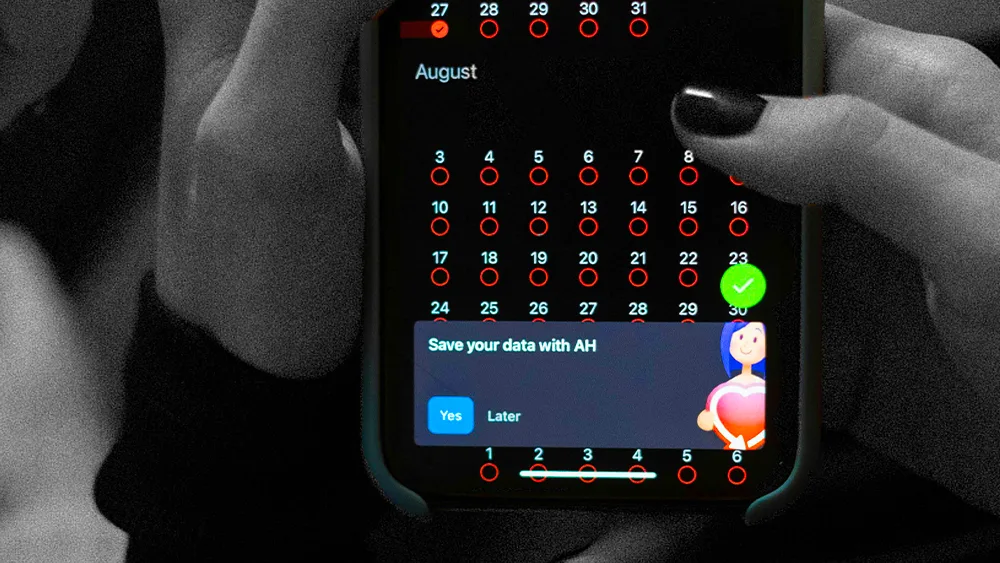
Humans are obsessed with data. We track our sleep, our steps, our heart rate variability, and our glucose levels with an arsenal of wearables and apps, all in the pursuit of optimizing our health. Yet for half the population, a powerful built-in diagnostic system is ignored, misunderstood or dismissed—only noticed when it seems 'broken.'
The reproductive system has long been defined by a single purpose: making babies. As a result, fertility is treated as a niche concern, relevant only when there’s a problem or a desire for children. But this view ignores a fundamental biological truth. Reproductive health is not a silo. It reflects overall vitality, and learning to read its signals is one of the most proactive steps toward better health.
We spoke with Michelle Snyder, a scientist and fertility educator on a mission to radically change how we think about reproductive health. As a Director of Science and the Founder of WTT Nutrition, Snyder turns data and clinical research into actionable guidance, empowering women to reclaim sovereignty over their own bodies. Her message is simple but profound: we need to stop seeing fertility as a switch to be flipped and start seeing it as a vital sign to be monitored.
- The early warning system: "For any human body, your reproductive health matters. It is the first thing to go when any imbalance exists, and it is the last thing you'll regain on your health journey." This isn't a philosophical statement; it's a biological one. Snyder explains that the reproductive system is the body's "lowest priority system." When faced with any threat—be it nutritional stress, environmental toxins, or mental anxiety—the body will always prioritize keeping the heart beating, the lungs breathing, and the brain thinking. You don't need to get pregnant to survive until tomorrow. Because it’s biologically “optional” for immediate survival, it serves as our most sensitive barometer for underlying imbalances, an early warning system that signals trouble long before it shows up elsewhere.
- A fringe benefit: This biological reality is completely at odds with how our healthcare system is structured. "We have to start redefining fertility from meaning babies to meaning health," Snyder argues. "It's a vital sign." This idea is central to a growing movement that considers the menstrual cycle a "fifth vital sign," a monthly diagnostic report on hormones, metabolism, and overall vitality. Yet in the workplace, it’s treated as anything but vital. "It's like, here are the health plan options, here's your vision and your dental. But the fertility still seems so fringe," she says, "It's treated as an optional bonus."
Faced with a system that is slow to change, Snyder advocates for a "bottom-up" approach. She argues the problem isn't just that women are under-informed, but that "they're not being listened to." This creates a gap where individual empowerment becomes the most effective tool for change. "My focus has been bottom-up because we can't count on the doctor's offices and the programs to do it for us," she explains. "While we need policymakers, that work takes so long. If I can make someone feel better about the issues they're facing today, it just makes the most sense to start there."
- A broken cycle: Snyder’s method involves teaching women how to use their cycle as a "diagnostic tool" to read their body's unique signals. By tracking specific biomarkers, women can move beyond generic advice and make targeted, evidence-based interventions for issues like a "short luteal phase or low progesterone." This foundational work stands in sharp contrast to more superficial wellness trends. "There's a lot of hype on cycle syncing, and I think that that's amazing," she says, "but you can't sync to a broken cycle."
- The 18-month off-ramp: Nowhere is the reactive mindset more apparent than with hormonal birth control. For many, it represents a decade-long solution that is expected to be turned off like a switch when it's time to conceive. This thinking, Snyder warns, ignores the profound physiological impact of hormonal contraception and the critical need for a transition period. "You need to give yourself the buffer time," she advises. "You need to get to know your rhythms, what your body is saying and what it's doing, before you can expect it to work. It's just like any other system in the world: you would want to get to know how it's operating before you try to use it."
Snyder's core message is one of proactive, informed consent. With under-discussed risks like ovaries shrinking by up to 50%, women should be empowered to mitigate them with solutions like liver support or targeted supplementation while on the pill. Based on scientific literature, she recommends giving your body an 18-month buffer after stopping birth control before trying to conceive—a timeline needed to re-regulate hormones, smooth out cycles, and truly understand your body’s baseline. The human impact of this transition can be staggering. "I hear a lot, 'Oh my God, I feel so different. I feel like a completely different person,'" Snyder says, underscoring the life-altering chemical changes at play.
- On the offensive: The journey to self-education can be daunting, often leading to a sense of hopelessness. Snyder acknowledges this, noting why her past attempts to help people on forums felt futile. "This is why the whole self-education is flawed," she says. "It makes you think you've tried everything and nothing's working." She counters this with a reassuring message: "there are answers for you," framing the solution as a "buffet of information" from which an empowered individual, ideally with expert guidance, can choose.
Ultimately, a proactive mindset is no longer optional. "We live in the most toxic—mentally, physically, environmentally—world in history. So you have to be on the offensive with this, not just the defensive. It’s such a disservice to yourself to wait until you think you might want kids or not care about it if you don't want kids."
.svg)