.svg)
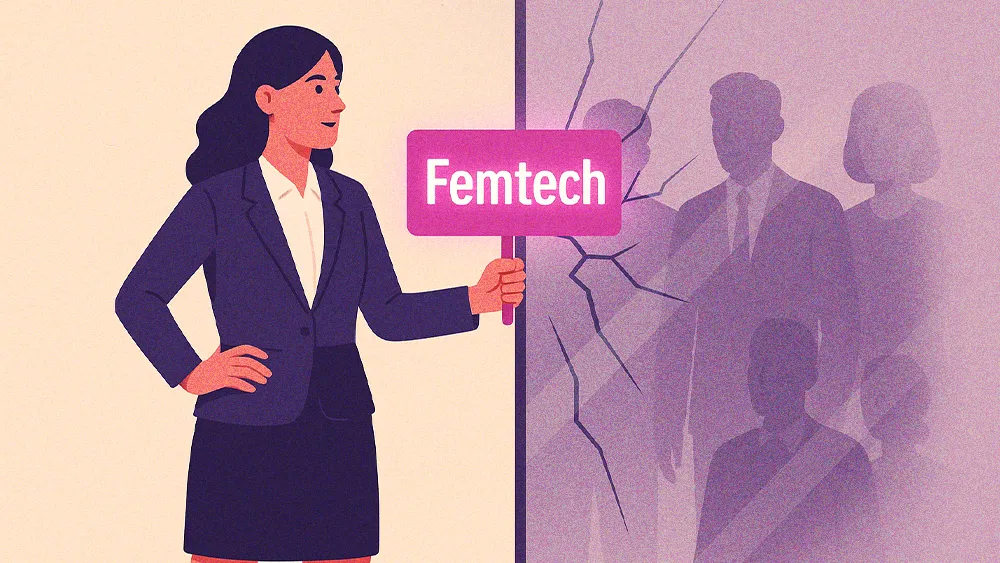

The term ‘femtech’ was coined to galvanize a movement, but has it become a cage? For a growing number of founders, the label intended to champion innovation for women's health has become an unhelpful, overly broad catch-all that devalues the very companies it aims to support. For investors, this has created a convenient, if flawed, excuse to dismiss an entire sector as "crowded" and "niche"—despite it serving half the world's population.
We spoke with Sarita Stefani, the Co-Founder and CEO of the reproductive healthcare platform Amilis. A winner of the Women's Health Ultimate Role Model Award 2024, Stefani has years of expertise in the healthcare tech industry and is a fierce advocate for improving research and outcomes in women's health. As a founder building a clinical company in this space, the 'femtech' label has become a significant and frustrating barrier to progress.
"How can it be a crowded market when there are two unicorns in the space compared to the hundred thousand I could name in fintech, and yet hundreds of thousands of women are still on the waiting list for a vaginal scan? Where are the success stories? I live and breathe this, and I can't see them." The "crowded market" claim is a rejection Stefani receives on an almost daily basis from potential investors. While she acknowledges the term's positive origins, she argues its overuse has turned it into a lazy pretext for dismissal.
This broad-brush labeling doesn't just impact funding; it fundamentally misrepresents the nature of the work. By grouping all women-focused businesses together, the term strips highly technical, science-backed companies of their clinical credibility. Stefani’s company, Amilis, is a prime example—a machine-learning platform for doctors that gets lost in a category it shares with direct-to-consumer goods. "On a daily basis, I receive an email saying, 'The market is crowded.' Which market is crowded? What are you talking about?" explains Stefani.
For Stefani, the path forward requires a radical shift from talking about the problem to actively normalizing a new reality. The solution isn’t more panel discussions about bias; it’s tangible action and visible representation that makes women’s leadership and health challenges a wonderfully unremarkable part of the business landscape.
This flawed system is built on a paradox. While investors dismiss the space as niche, women hold over 80% of the purchasing power in the world, a fact Stefani notes is consistently overlooked. The core issue, she concludes, is a fundamental miscategorization. The "femtech" label has allowed the industry to quietly cordon off women's health from "real" healthcare, obscuring a massive market opportunity in plain sight.
"They don't see us as healthcare. We are 'femtech' because we serve women. Healthcare and 'femtech' are seen as completely distinct, and that's a huge part of the problem."