September 18, 2026
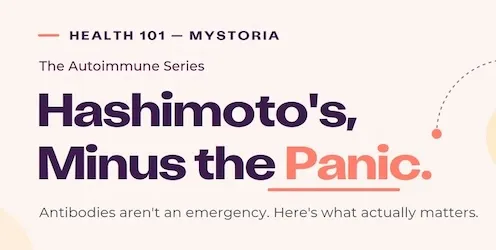
Hashimoto's, Minus the Panic

Hashimoto's antibodies aren't an emergency, and no diet reverses it. What the condition actually is, when treatment starts, and which fixes fall apart.

.svg)




What's actually happening in your body — phase by phase
Here's something that should have been taught in school but wasn't: your menstrual cycle is one of the most powerful health signals your body sends you every single month. The American College of Obstetricians and Gynecologists (ACOG) formally calls it a vital sign, as important to your overall health picture as your blood pressure or heart rate.
And yet most people grow up knowing only the bare minimum: you bleed once a month, it might hurt, and then it stops. What actually happens in between (the hormonal orchestration, the phases, the signals your body is constantly sending) rarely gets a proper explanation.
This post is that explanation. We're covering the three phases of your menstrual cycle: what's happening hormonally, what's happening physically, and how each one might make you feel. Think of it as the foundation for everything else.
Your cycle is measured from the first day of your period (Day 1) to the day before your next period begins. According to FIGO guidelines, a normal cycle can range from 24 to 38 days. Fewer than 15% of people have a textbook 28-day cycle, so if yours doesn't match, you're in the majority, not the exception.
Day 1 is the first day of full flow bleeding, not spotting. That distinction matters when you're tracking.
📌 Also worth knowing: Your cycle is actually two cycles...



With a background in nursing and a genuine passion for care, Jessie supports myStoria members as part of the Concierge team.